How a Leadership Development Consultant Helps Leaders Reinforce Values
Written by Sheryl Hicks
| March 2, 2026

Every job candidate has experienced it: A company stands out from the pack because it highlights its commitment to values you truly care about when you’re introduced to the organization, only for those values to never be reflected in the leadership team’s day to day once you land the job.
This isn’t to say that the average business leader doesn’t care about company values. But when they’re inundated with deadlines and high-priority decisions, they may act according to their gut feelings instead.
As CHRO, you understand how much subtle damage this can do to a company’s culture. When employees see leaders behave in ways that aren’t consistent with the values they promote, it breaks down trust in leadership and leads to cynicism. The culture you’re trying to build disintegrates, and one full of negativity takes hold.
Fortunately, it’s possible to teach leaders to habitually live by their values. Partnering with a leadership development consultant can help.
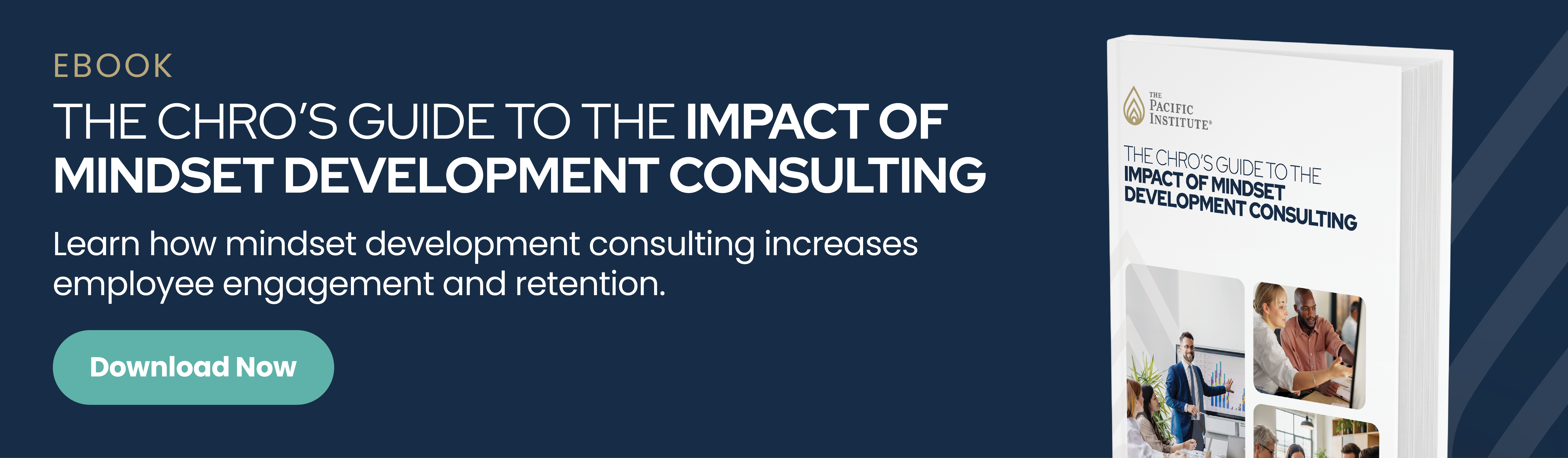
Download the eBook — The CHRO’s Guide to the Impact of Mindset Development Consulting
How Mindset Development Helps Leaders Live by Their Values
To change how they behave, leaders first need to change how they think. Thoughts drive beliefs, and beliefs drive actions, so our most habitual patterns of thinking shape how we see ourselves, how we see the world, and how we engage within it.
These habitual patterns are our mindsets. When a leader’s mindset is rooted in fear or negativity, for example, they’re more likely to slip into self-preservation mode — reducing risk and protecting status rather than acting with courage and integrity. But when their mindset is positive and confident, they’re far better equipped to live their values through their actions.
As a result, leaders who engage in mindset consulting are better able to cultivate:
- Psychological safety: Psychological safety occurs when people feel comfortable speaking their minds. The question of how to improve psychological safety in the workplace is best addressed when leaders develop the capacity to be open to feedback and listen to new ideas with patience and compassion.
- Trust and transparency: If a leader has a confident mindset, they won’t hesitate to be transparent about their actions, motivations, and challenges. This openness fosters a culture of trust.
- Inclusion and fairness: Leaders who have examined their mindsets have also examined their biases. They know how to make every individual feel included, driving stronger teams while ensuring diversity, equity, and inclusion metrics reflect meaningful impact, not just compliance.
- Collaboration and shared accountability: A leader with a healthy mindset doesn’t try to do everything alone or avoid responsibility. Instead, they model effective collaboration and shared ownership.
The Role of a Leadership Development Consultant
Of course, teaching someone a whole new mindset isn’t a simple task. It generally can’t be accomplished with short-term training or skills workshops. The only reliable way to shift someone’s mindset is with the help of a leadership development consultant who specializes in doing just that.
A leadership development consultant helps leaders optimize their mindsets by teaching them to:
- Build emotional regulation skills so they stay calm under pressure, making it easier for them to think about values before taking action
- Increase self-awareness so they can better recognize mismatches between stated values and actual behavior
- Strengthen their empathy so they can foster psychological safety and mutual respect
- Clarify decision frameworks so they can apply company values to decisions
- Create accountability structures to help reinforce behavior change
While the average leadership workshop gives a shallow overview of specific skills, mindset-based consulting gives leaders a deep understanding of how to act on their values every day.
The Metrics that Grow with Values-Based Leadership
Leaders with healthy, values-driven mindsets produce a more engaged and productive workplace culture. This is reflected in key metrics CHROs track, including:
- Employee satisfaction scores, especially those related to psychological safety. Leaders who receive mindset consulting learn to create an environment where employees feel heard and respected.
- Metrics that demonstrate high levels of collaboration and cross-functional alignment, including interdepartmental satisfaction scores and faster cycle times for multi-team initiatives. Leaders with optimized mindsets have the communication and collaboration skills needed to work well across departments.
- Diversity, equity, and inclusion metrics, such as retention among underrepresented groups and promotion equity. Leaders who have examined the biases in their mindsets treat all employees fairly, living by company values around inclusion and diversity.
- Trust in leadership, as represented through 360-degree reviews and other manager satisfaction surveys. When a leader has been trained to act according to their values, employees notice and develop greater respect for them.
7 Ways to Help Leaders Sustain Values-Based Habits
Beyond working with a leadership development consultant, there are tangible actions leaders can take to make values part of their daily habits and deepen the relationship between leadership and trust. Some strategies you can try include:
1. Translating company values into concrete behaviors
It can sometimes be difficult for people to picture what it looks like to live according to certain values. Connecting each value to specific actions can help. For example, if one of your values is innovation, corresponding actions might be promoting psychological safety and treating failure as an opportunity.
2. Integrating values-related behaviors into 360-degree reviews and leadership assessments
Instead of just looking at whether leaders delivered results, focus your assessments on whether leaders delivered results through values-aligned behaviors. You can also evaluate how often leaders perform the behaviors identified in the previous step.
3. Building accountability systems to reinforce values
Create systems of accountability, including leadership commitments, peer accountability groups, and regular values check-ins during meetings. These structures reinforce shared responsibility and encourage leaders to support each other in living the company’s values.
4. Embedding corporate values into decision-making frameworks
Make sure values are mentioned in decision-making guides leaders use. To normalize connecting decisions to values, also encourage leaders to name company values when explaining their decisions.
5. Encouraging managers to model values in daily operations
Help leaders find ways to integrate corporate values into their everyday work. This may involve discussing values in one-on-one meetings, using values in conflict resolution, or recognizing team members who embody company values.
6. Tracking progress using metrics related to culture alignment
You can track whether leaders are living according to company values with the same metrics you currently use to measure cultural health, such as:
- 360-degree reviews
- Psychological safety indicators
- Cross-functional collaboration scores
- DEI markers
- Leadership consistency ratings
If these metrics are improving, it’s likely a sign that leaders are behaving in more values-driven ways.
7. Supporting leaders with consulting engagements to help them develop their mindsets
Give leaders the tools they need to change their behaviors for the better by letting them meet with a leadership development consultant who specializes in mindset training. These consultants help leaders discover what aspects of their mindsets are holding them back, then teach them to develop more positive mindsets. Armed with this knowledge, leaders can better translate company values from ideas to habitual behaviors.
Values Become Culture Only When Leaders Live Them
The most well-thought-out company values are little more than empty platitudes unless leaders live by them. However, even the best-intentioned leader can struggle to apply their values consistently when working under pressure.
Fortunately, CHROs are uniquely positioned to make values a part of company life. This work can have an even greater impact when done in partnership with a leadership development consultant, who can teach leaders the mindsets they need to make values-driven leadership intrinsic to how they communicate, lead, and make decisions.
With these supports, values move from words to concrete actions and then, ultimately, become embedded in your company’s identity.
To begin building your values-based identity, contact The Pacific Institute today.