How Leadership Coaching from The Pacific Institute
Drives ROI
Written by Richard Resnick
| December 15, 2025

Your mission as a CEO can be boiled down to two goals: increase revenue and grow the business. But within those simple directives lies a world of complexity. Even small factors can indirectly impact revenue, and CEOs are under pressure to account for every variable.
Consider leadership quality. There's a documented leadership gap in most organizations, meaning current leadership skills aren't sufficient to meet future business needs. This talent issue can stall innovation and dampen morale — both of which slow growth.
Closing this leadership gap requires more than upskilling. Leadership quality depends as much on a leader's mindset as on their skillset.
It may sound daunting to influence your leadership team's mindsets, but mindsets can be developed just like any other capability. Skilled leadership coaches can help shape your team's mindsets, close leadership gaps, and support long-term business growth.
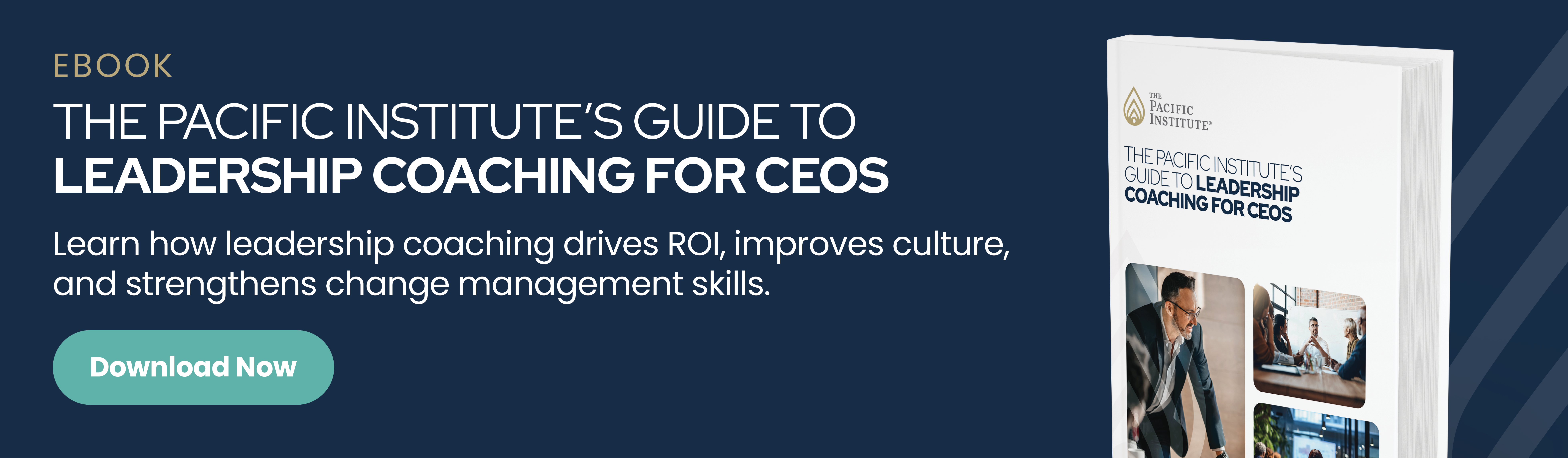
Download the eBook — The Pacific Institute's Guide to Leadership Coaching for CEOs
How Do Leadership Gaps Harm Business Performance?
Leadership gaps occur when leaders don't have the ability to energize their teams, make informed decisions, or take calculated risks — all of which impact revenue.
When leaders aren't equipped to energize their teams, engagement and productivity drop. Work quality suffers, and employees may leave for greener pastures.
Misalignment can also grow within and between teams, slowing projects and go-to-market efforts. This is often compounded by slow or risk-averse decision-making among untrained leaders. These leaders may make choices driven by fear or emotion rather than fact, steering your business in the wrong direction.
How Does Leadership Coaching Improve ROI?
Research suggests executive coaching ROI is very high, with estimates placing total returns between 340% and 700%. One survey found that 87% of respondents reported high executive coaching ROI. Contributing to those gains, 84% observed increased leader effectiveness and 88% saw higher workforce engagement.
Part of this high ROI can be attributed to costs saved from lower employee churn, which multiple studies and articles have linked to strong leadership development. Not only do employees stay when leaders receive effective coaching, but their higher engagement makes them more productive and inclined to suggest innovative ideas.
Leaders are also more innovative after receiving coaching because they've mastered mindsets that promote confident decision-making. This means smarter, more creative business decisions.
The result is larger margins and higher revenue. According to McKinsey, the EBITDA margin of organizations with top-quality leadership is almost double that of others. After investing in a leadership coaching program, Intel estimates that it added $1 billion to its operating margin.
The Concrete Outcomes of Leadership Coaching
Why does this margin growth happen? Here are some ways leadership coaching contributes to business growth:
- Higher-quality decisions from leadership. Healthy mindsets empower leaders to make decisions unclouded by emotions. They're able to see things for what they are and make informed decisions with confidence.
- Faster innovation cycles. Leaders with improved decision-making skills can move quickly to capitalize on innovative new ideas. They have the interpersonal skills to successfully manage change as the organization innovates.
- Improved alignment and accountability. Leaders who have undergone coaching are more likely to take ownership of their actions. They communicate more clearly, collaborate more effectively, and support stronger cross-team alignment — enabling everyone to contribute at their highest level.
- Employee engagement and ownership. Great leaders help employees feel respected, valued, and encouraged to take ownership of their work. This leads to higher performance and better retention.
What CEOs Should Look for in a Coaching Partner
Of course, not all leadership coaching is created equal. The coaching industry is rife with consultants who lack reputable, science-backed methods. When looking for a leadership coaching partner, ask questions to ensure you're working with someone trustworthy who:
- Uses proven frameworks. Many coaches employ strategies that may feel right in the moment but aren't supported by evidence. When these coaching sessions are over, no long-term changes have been made. However, coaches who use proven frameworks backed by psychological research can make a lasting impact.
- Measures pre- and post-coaching impact. A credible coach tracks results. They'll conduct a baseline assessment and then repeat it afterward to quantify whether meaningful mindset shifts have occurred.
- Links mindset changes to business KPIs. The best coaches take time to understand your business's pain points and design coaching that addresses them. They'll cultivate the mindset shifts your leaders need to support business growth.
How The Pacific Institute's Leadership Coaching Delivers ROI
The Pacific Institute prioritizes your business's success by delivering coaching built on proven, science-backed frameworks.
TPI's coaching methodology centers on how thought patterns shape behavior. It targets leaders' mindsets, rather than isolated behaviors, to ensure lasting change. Diagnostic tests are delivered before coaching to quantify leadership gaps and again afterward to ensure those gaps were addressed.
While many leadership coaches offer feel-good courses with limited long-term impact, TPI prioritizes practical instruction aimed at enterprise-level outcomes. Consultants coach leaders in ways that directly support the organization's KPIs.
TPI's model is structured enough to be broadly applicable, yet flexible enough to be tailored to your organization's needs. This makes it scalable across teams and departments, enabling business-wide cultural transformation.
Close Leadership Gaps With Science-Backed Leadership Coaching
Pervasive leadership gaps affect organizations of every kind, but with leadership coaching, these gaps can be fixed.
Science-backed coaching has been shown to increase organizations' ROI, leading to higher margins and lower employee churn. By developing more productive mindsets in leaders, companies can foster lasting behavior change across their leadership teams.
To see what benefits leadership coaching could bring to you as a CEO and your leadership team, connect with The Pacific Institute to discuss the potential ROI.