Defining Responsibility: What It Means in Life and the Workplace Responsibility
Written by The Pacific Institute
| May 3, 2021

Defining responsibility is the first step in understanding and accepting one’s influence. In life, responsibility often shows up through personal commitments and the consequences that come from failing to follow through. In the workplace, it becomes something larger, a shared standard for how leaders and employees respond to expectations of one another.
If leaders want to consistently define responsibility in their organization, they must model accountability and authenticity for their team. In this article, we will explore how leaders can create the conditions where people understand their roles and the impact they play within company culture.
What is the definition of responsibility?
According to Merriam-Webster, the simple definition of responsibility is both “the quality or state of being responsible” and “something for which one is responsible.” In other words, responsibility encompasses either a state of ownership and accountability, or a set of specific duties and obligations.
Most people are taught personal responsibility as children, and learn from their experiences with keeping promises, telling the truth, and accepting consequences. As they get older, that relationship to responsibility follows people into the workplace, and influences how employees and leaders are willing and able to show up when the stakes get higher.
What are the qualities of a responsible leader?
The qualities of a responsible leader begin with ownership and self-awareness. Effective leaders pay attention to how their behavior influences the standards that are practiced across the team, as well as the company culture. When the people at the top understand the impact of their energy, they can act with greater intention.
In the workplace, responsibility is not defined only by who completed the task or who missed the mark. Leaders are being asked to create the conditions where people understand how their role connects to the larger organizational picture. That understanding brings meaning to peoples’ work, and inspires self-direction and collaboration.
Responsible leaders often demonstrate qualities such as:
- Emotional Intelligence: They recognize how their reactions affect the people around them. When pressure rises, they are able to regulate themselves before asking others to respond well.
- Curiosity: Responsible leaders do not enter situations assuming they already understand the full picture. Instead, they lead with questions so they can see what is really driving buy-in or resistance, and resist being intimidated by unfamiliar information.
- Accountability: They take responsibility for their decisions and the environment those decisions create. They do not push accountability onto employees while ignoring their own role in the outcome.
- Mindset Modeling: One of the biggest responsibilities of a leader is modeling the beliefs and behaviors they want to see in the organization. If they want ownership, adaptability, and follow-through, those standards have to be visible in how they lead on a daily basis.
- Responsiveness: They respond to issues instead of avoiding them. Responsible leadership means addressing tension early enough that ambient discomfort does not become a part of the culture.
- A Willingness to Improve the System: Leaders look beyond individual behavior and ask whether the structure of work is helping people succeed or making responsibility harder to practice.
Imagine that a leader is noticing that a team keeps missing deadlines. Instead of placing blame on one department or jumping to look for who needs to be fired, they get curious about the source of delivery gaps and communication breakdowns. Creating opportunities for cultural transformation helps teams define responsibility for their individual roles within the larger system.
Feeling like your team is struggling with misalignment? Book a consultation with us to get a gauge on the state of your company culture.
6 changes to how we define responsibility in the workplace
Work culture has changed significantly since the pandemic, and many traditional ideas about workplace responsibility no longer apply in the same way. Employees are still expected to complete their work, but leaders now have a greater responsibility for creating an environment where ownership can actually take root.
When leaders are out of touch with modern workplace expectations, responsibility can start to feel like a demand instead of a shared standard. These are six factors to keep in mind as you set expectations for employees.
Rise of Remote Work
Remote and hybrid work changed the way many organizations think about responsibility. Gallup reports that 60% of remote-capable employees want hybrid work, about one-third prefer fully remote work, and fewer than 10% prefer to be fully on-site. “Showing up for work” is about what employees bring to their role rather than the time they clock in.
That shift has forced leaders to examine what they really believe about trust. If responsibility is measured by visibility, then remote work can feel like a threat. But if responsibility is measured by clarity, follow-through, and results, then flexibility becomes easier to lead. Responsible leadership in a remote or hybrid environment means replacing micromanagement with trust that is earned in both directions.
New Generational Perspectives
A new generation of employees is entering the workforce with different expectations for leadership. This is not a “kids these days” issue—it is a workplace reality leaders have to understand if they want to attract, develop, and retain strong people in the years to come.
Forbes has noted that Gen Z is helping push leadership toward more collaborative and empathetic models, with higher expectations around:
- Transparency
- Mental health
- Technology adoption
- Social responsibility
- Diversity, equity, and inclusion
This change in workplace expectations isn’t equivalent to younger employees rejecting responsibility. In many cases, they are asking for a clearer relationship between responsibility, purpose, communication, and support. Responsible leadership means listening closely enough to understand what has changed without dismissing the people bringing that change into the workplace.
Normalization of Job Hopping
Job movement no longer carries the same stigma it once did. For many employees, changing roles is seen as a practical way to grow or find a better cultural fit. That reality raises the standard for leaders.
If people no longer feel obligated to stay in unhealthy or unclear environments, then employee responsibility and leadership responsibilities become more connected. This begins with building a culture where strong people can see a future. Employees are responsible for how they contribute, but leaders are responsible for building a workplace worth committing to.
Trustworthy cultures retain people not by demanding loyalty, but by creating the kind of environment where loyalty makes sense.
Work-Life Balance
Work-life balance has moved from a personal preference to a serious workplace expectation. Employees are paying closer attention to whether their work supports a sustainable life or works against it, and they’re willing to walk if need be
Employees have a responsibility to do their jobs, but they also need to feel secure going to their leaders when the work is driving them towards burnout. In exchange, leaders need to be ready to take feedback and see what creative solutions are available to help retain talent.
Some workers are willing to trade compensation for workplace flexibility—and often, the ROI is worth it for employers. Studies have shown a 20-40% improvement in productivity and improved levels of well-being for companies that adopt a four-day workweek.
AI Utilization
AI is changing how companies define responsibility in daily work. Employees are responsible for using AI with proper judgment, and leaders are responsible for setting clear expectations around appropriate use and how AI adoption should support the organization’s culture.
This is where leadership can either create confidence or confusion. If AI is introduced without communication, people may fill the silence with fear. If it is introduced with a human-centered approach, it can become a tool that supports better work instead of threatening people’s sense of value.
For The Pacific Institute, this connects directly to the larger cultural idea: people respond to change based on what they believe the change means. If your employees believe AI makes them expendable, you’ve lost buy-in for a valuable tool for the start. If they believe it’s here to support the skills and experience they bring as humans, you make room for innovation.
The Call for Leaders Who Care
90% of people who quit their jobs cite their boss as the reason they’ve quit, with 58% naming bad management as the primary factor. Even if people love their job in theory, the person they report to has the greatest impact on whether they stay, grow, disengage, or leave.
Responsible leaders own their influence, and are willing to have the difficult conversation early. They care enough to self-regulate even in high windows of stress and model the behaviors they expect from their team.
In that way, responsibility in the workplace mirrors personal responsibility. “Am I owning the influence I have, or am I avoiding it?” Leaders have to ask themselves whether they are accountable to the people they lead, not only the outcomes they are measured by.
Bridging the gap: leadership and employee responsibility
Responsibility in the workplace moves in more than one direction. Leaders carry responsibility for the conditions they create, the standards they model, and the way accountability is practiced across the culture. Among the most important responsibilities of a leader is making ownership clear enough that people know what is expected of them and why it matters. Employees carry responsibility for their effort to own their part of the work.
The gap between employee responsibility and leadership responsibilities closes when both sides understand what they owe to one another. Leaders owe people consistency and a culture where ownership is supported. Employees owe the organization honesty and a willingness to engage with the work in front of them.
This is how responsibility becomes more than a stated value. It becomes how the team operates. When people believe their actions matter, they are more likely to take ownership. When leaders reinforce that belief through behavior, responsibility becomes a cultural standard instead of a word on the wall.
Defining responsibility from the inside out
Defining responsibility in the workplace starts with the way people see themselves, their role, and their influence. Policies can clarify expectations, but transformational leadership begins from the inside out. Leaders shape culture through the beliefs they model, and it begins with the power of mindsetting.
When responsibility becomes part of how people think, it becomes part of how they lead and perform. For organizations working to build stronger accountability and culture, the next step is understanding where leadership is today, how clearly leadership responsibilities are being modeled, and what changes can help organizations thrive.
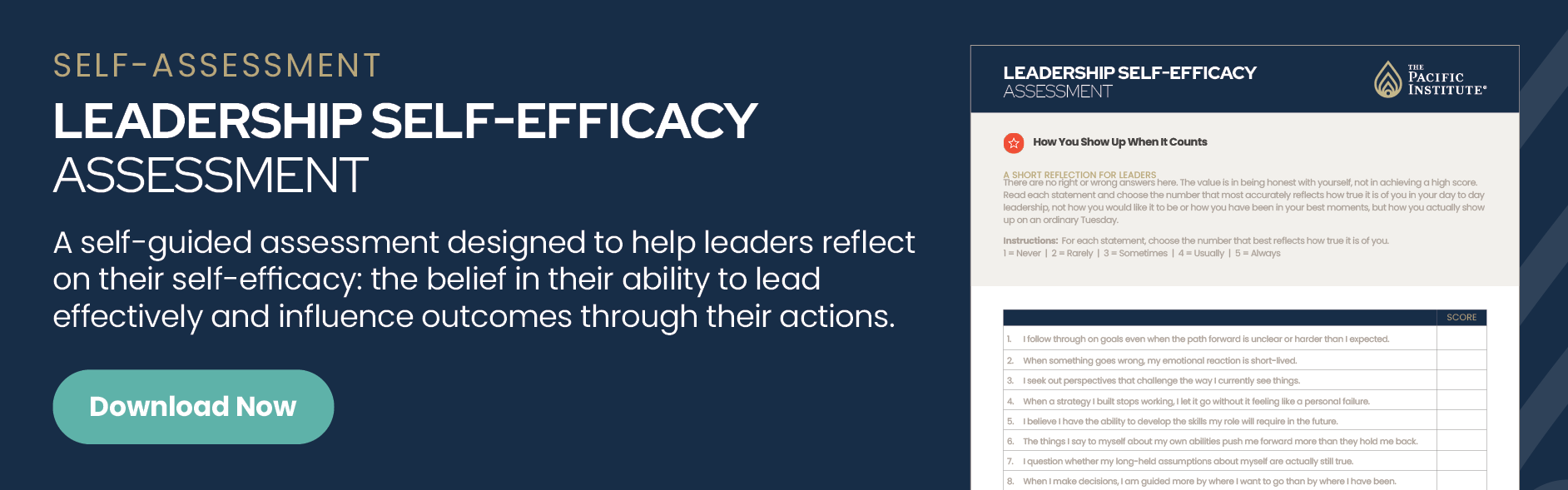
Take the Leadership Self-Efficacy Assessment to begin that process.