Why CHROs Need Mindset Development Consulting to Boost Employee Morale
Written by Sheryl Hicks
| February 13, 2026

Today’s businesses are navigating an employee morale crisis: Only 18% of U.S. employees are extremely satisfied with their jobs, and 51% are seeking new opportunities, according to Gallup.
As a CHRO, it’s your job to look beyond “quick fixes” like perks and address the psychological drivers that keep teams down, including low morale and reduced capacity to cope with ongoing change.
By partnering with employee engagement consultants, you can shift the organizational mindset to foster sustained performance, adaptability, and productivity.
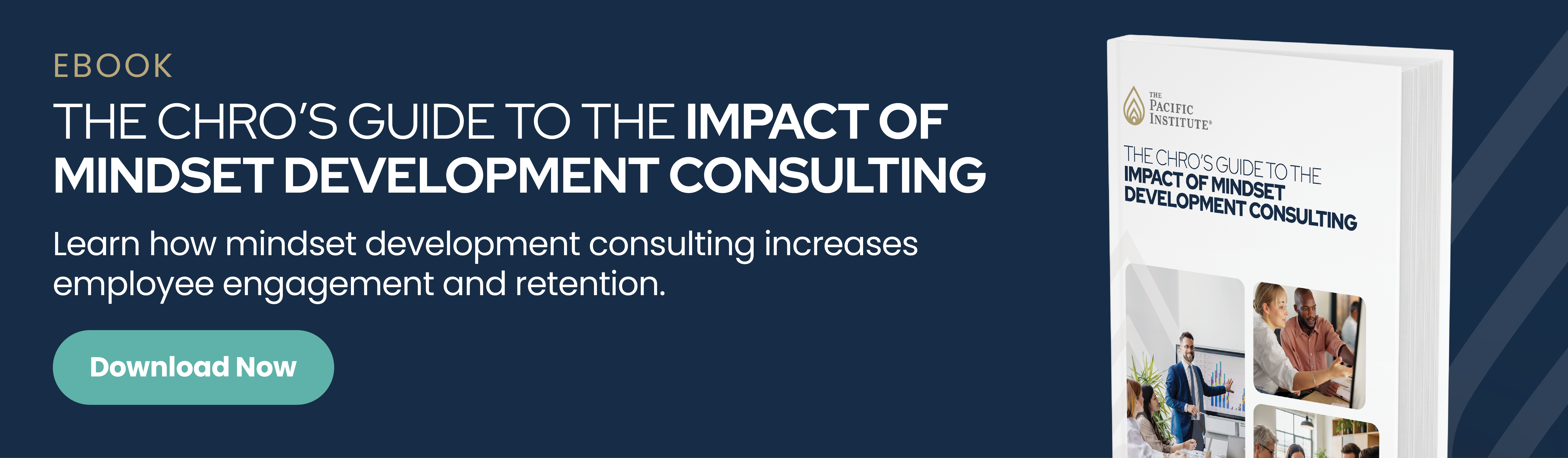
Download the eBook — The CHRO’s Guide to the Impact of Mindset Development Consulting
What’s the Relationship Between Employee Morale and Resilience?
Employee morale is the collective sentiment and energy employees bring to their work. When morale is high, employees have a strong sense of purpose — even during challenging times. They also experience psychological safety, or confidence that they can speak up or raise new ideas.
Morale and resilience are closely related. Resilience is the ability to recover from setbacks and adapt to change. Resilient employees are more open to new approaches, more willing to take thoughtful risks, and less likely to view change as a threat. Instead, they see it as an opportunity for growth.
If you’ve been struggling with how to reduce employee resistance to change, strengthening employee resilience is often the missing piece.
Does Employee Engagement Improve Business Performance?
Improving employee engagement and promoting employee morale aren’t just feel-good goals; they contribute to measurable business outcomes.
Does employee engagement improve business performance? According to Gallup, productivity levels are up to 18% higher in engaged teams, and businesses see up to 23% higher profitability. Other benefits include:
- Higher eNPS scores: Teams that feel positively about the organization are more likely to recommend it to potential employees as well as potential customers.
- Better change adoption rates: If you’re looking for how to reduce employee resistance to change, cultivating resilience and engagement is often the answer.
- Improved engagement scores: Teams with high employee morale are more engaged, giving you higher survey scores for stakeholders.
The Difference Mindset Development Consulting Makes
Many training programs focus on highly specific skills or surface-level positivity. These types of trainings rarely make a lasting impact on either morale or resilience.
Mindset development consulting focuses on improving how employees think, feel, and make decisions by teaching them how to replace negative thought patterns with productive ones.
The Pacific Institute applies mental technology designed to do exactly that. It helps people cultivate growth mindsets by eliminating subconscious thought patterns driven by fear or negativity. Employee engagement consultants teach your team to adopt thought patterns that are confident, forward-looking, and positive. This helps them gain the outlook needed to react productively to stress or change.
Teams that have received this training are less likely to panic over a setback, resist change, or check out when a project is difficult. Research shows that organizations using mindset development consulting see employees who are less likely to disengage when faced with obstacles, have a problem-solving attitude, embrace change, and work all the more diligently when a project proves challenging.
5 Steps for Building a Culture that Supports Employee Morale
To create lasting changes in employee morale and resilience, follow these steps:
Step 1: Pinpoint key problems
Investigate what causes morale to sink to its lowest and what problems have the team feeling stuck. Take the time to connect with and listen to employees to get a comprehensive view of what issues most need to be addressed.
Step 2: Investigate consulting options
Explore consulting partnerships capable of addressing the specific morale-related issues you see in your organization. Prioritize partners with expertise in shifting mindsets and building sustainable habit changes over those that focus on surface-level fixes.
Step 3: Work with your consultant to build a plan
Collaborate with the consultant you’ve chosen to build a plan for supporting positive, resilient mindsets throughout the organization. Discuss the key problems you uncovered and how mindset coaching can be scaled across the organization to address them.
Step 4: Integrate supportive norms into the whole organization
With the help of your consulting partner, develop strategies for creating norms that promote high employee morale during your organization’s day-to-day operations. Consider factors like clear communication and psychological safety. Also prioritize leadership training focused on modeling positive norms and mindsets to the whole organization.
Step 5: Build a structure for regularly tracking success
Determine how you’ll measure the success of your efforts over time. Consider distributing assessments like engagement surveys and pulse checks at regular intervals, and establish feedback loops that give employees channels for speaking up.
Support Your Team with Mindset Development Consulting for Morale
Resilience and morale are often seen as secondary concerns, but your business can’t meet its primary goals without addressing them. These factors determine whether employees stay with the company, remain productive through challenging times, recommend your business to others, and more.
When change and uncertainty plague the economic landscape, though, you need a little help to cultivate these traits in your employees. By partnering with experienced employee engagement consultants, organizations can build the psychological foundation required for long-term success.
Contact The Pacific Institute to learn more about how you can boost morale and resilience throughout your organization.